The Billables AI Blog
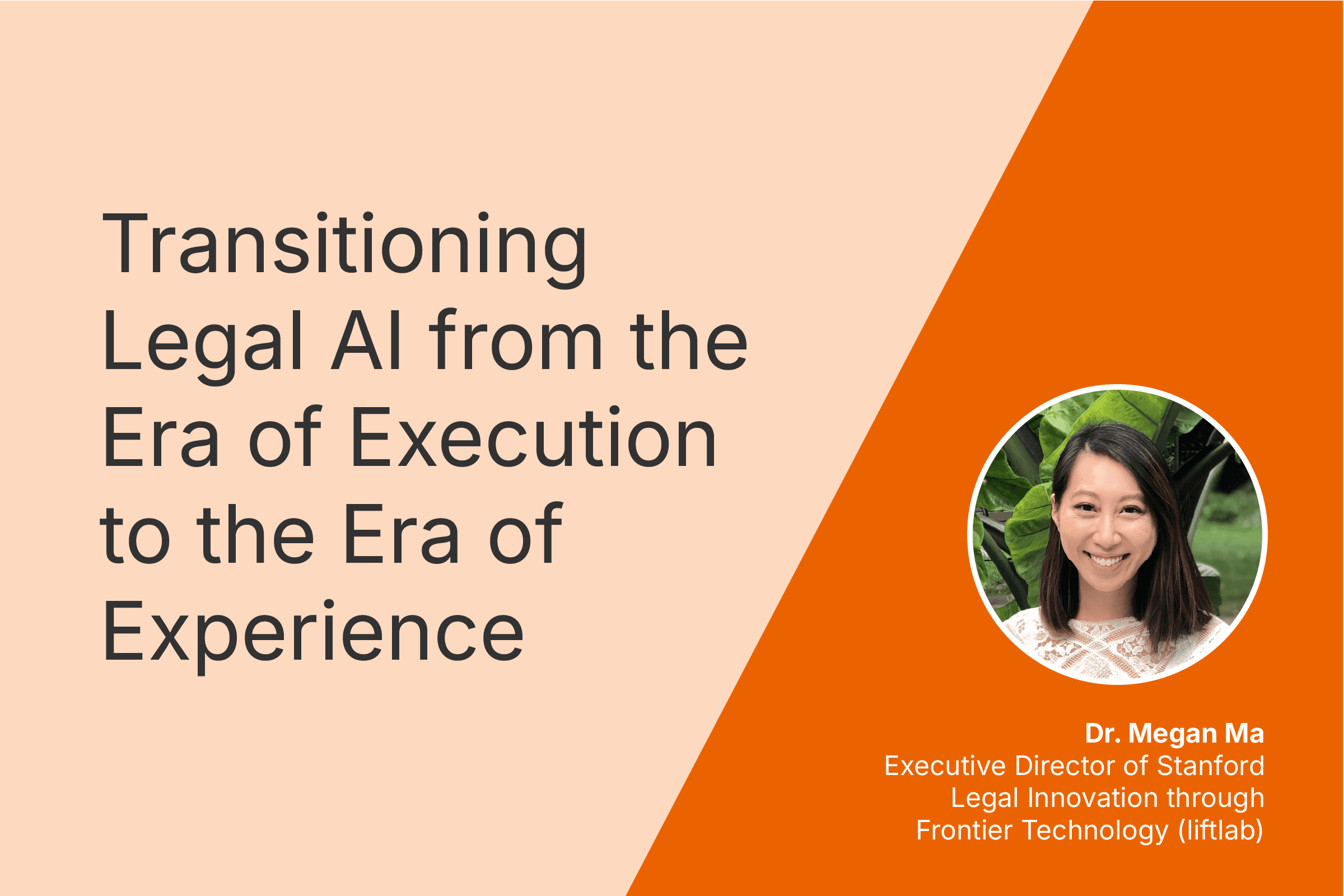
Transitioning Legal AI from the Era of Execution to the Era of Experience
Trends
Opinion
December 15, 2025
In his seminal work The Common Law, Justice Oliver Wendell Holmes Jr. famously declared, "The life of the law has not been logic: it has been experience." Holmes argued that the formal structures of the law—its axioms, corollaries, and codified rules—were merely the skeleton of the profession. The living body of the law, its true "life," was derived from the felt necessities of the time, the intuitions of public policy, and the practical wisdom gained through the friction of human interaction.
The first wave of generative AI in legal practice has been defined by a focus on execution—the precise mimicry of explicit text and the rapid generation of end-stage legal work products. We have built systems that can draft a contract or summarize a pleading with remarkable fidelity. Yet, these systems remain distinct from the "life" of the law. They possess the output but lack the process. To truly integrate artificial intelligence into the legal sphere, we must transition from an era of execution to what Richard Sutton, the "godfather" of reinforcement learning, describes as the "Era of Experience" (see discussion here).
Current legal technology is predominantly focused on the fidelity of technical output. We judge large language models (LLMs) by their ability to retrieve the correct case citation or draft a clause that mimics a senior partner’s style. This is the "Era of Execution." It treats the practice of law as a series of discrete, text-based tasks: read X, summarize Y, draft Z.
While valuable, this approach suffers from a critical limitation: it relies entirely on "explicit knowledge." Explicit knowledge is information that can be codified, written down, and found in textbooks or precedent databases. However, a significant portion of a lawyer's value is not explicit. It is the "implicit knowledge" developed over years of practice (e.g., the strategic silence during a negotiation, or the ability to navigate intricate client relationships). Current AI models execute the what of the law without understanding the how or the why that comes from experience. They provide the answer without having lived the journey of reasoning that justifies it.
A significant portion of a lawyer's value is not explicit. It is the "implicit knowledge" developed over years of practice.
This limitation is not unique to law; it is a central debate in the field of artificial intelligence itself. Richard Sutton, a pioneer in reinforcement learning, has recently distinguished between the "Era of Human Data" and the "Era of Experience." Sutton argues that current models are largely limited because they learn by imitating static datasets. In effect, they are reading about the world rather than living in it.
Sutton envisions a transition to an era where models learn through interaction, feedback, and the continuous stream of experience, much like a human apprentice. In the legal context, this distinction is profound. If we continue to train models solely on "end-stage work products" (e.g. final contracts, filed briefs), we are only teaching the AI the destination. We are failing to teach it the expedition (e.g., the drafts that were rejected, the phone calls that changed the strategy, or the lessons drawn from recalling “anec-data” (anecdotal experiences) that distinguish a senior partner from a junior associate).
The transition to the Era of Experience in legal AI requires us to capture and integrate the processes and learned habits of the profession, not just its outputs. A contract is not merely a document; it is the fossilized remain of a dynamic negotiation. To move beyond execution, legal AI must begin to unpack the deep implicit insights that drive legal work. For example, “execution-focused AI” views a merger agreement as collections of clauses to be assembled and analyzed on the premise of patterns of consistency between them. An experience-focused AI would view it as a tool for risk allocation owed to specific leverage points in the historical relationships between the parties.
The transition to the Era of Experience in legal AI requires us to capture and integrate the processes and learned habits of the profession, not just its outputs.
This requires a shift in how we build these systems. We must move beyond "Context" windows filled with static text and towards "Experience" windows that capture the decision-making process. We need systems that can observe the attorney's mind: how they prioritize facts, how they assess the emotional temperature of a client, and how they balance competing strategic interests. It is in these subjective, often unwritten habits that the value add of the attorney resides.
To capture these insights, we must also interrogate the "Operating System" (OS) of the law firm. Historically, systems like time and billing software have been viewed largely as administrative necessities (i.e., tools for accounting as opposed to the firm’s underlying intelligence). However, in the Era of Experience, these platforms represent a crucial, underutilized dataset of legal judgment. They record the pulse of the practice: the allocation of seniority to specific tasks, the time weighing of complex strategic versus routine drafting, and the collaborative networks between practice groups. This data reveals the "how" of legal work, the hidden architecture of resource allocation and prioritization that constitutes the firm's expertise. This operational data is a map of the experiential process, revealing where subjective value is actually being applied.
Historically, systems like time and billing software have been viewed largely as administrative necessities... However, in the Era of Experience, these platforms represent a crucial, underutilized dataset of legal judgment.
Transitioning to an Era of Experience is then not merely a technical necessity. There are equally economic implications. The "billable hour" model has long rewarded execution (time spent), but AI is rapidly driving the cost of execution to zero. If the generation of a 20-page memo takes ten seconds, the economic value of execution collapses.
In this new era, value must be defined by the quality of the experience: the advocacy, the advice. If legal AI can transition to understanding and replicating the "experience" of a seasoned lawyer, we can begin to define new economics of practice. We can shift from charging for the time it takes to write the document (execution) to charging for the process of navigating the legal problem (experience).
Furthermore, this shift dictates how we must assess quality. Currently, we evaluate AI based on accuracy and comprehensiveness. In the Era of Experience, quality assurance must assess the process. We must develop the metrics of experience.
Holmes was right: logic alone is insufficient. A lawyer armed only with logic is a technician, but a lawyer armed with experience is a counselor. As we continue to integrate generative AI into the legal profession, we must not be content with building highly efficient technicians that can merely execute commands. We must strive to build systems that participate in the experience of the law. That is, systems that understand the implicit, subjective, and deeply human processes that drive legal resolution. Only by embracing this Era of Experience can we ensure that legal technology amplifies, rather than erodes, the value of the profession.